
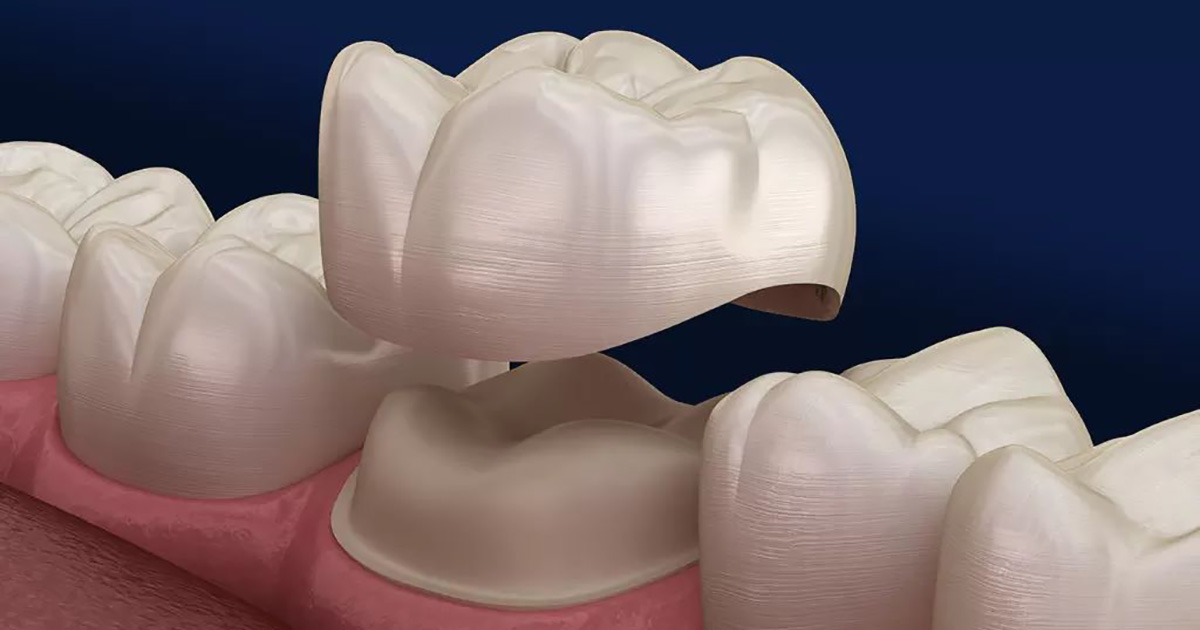
One of the challenges in restorative dentistry is that teeth usually don’t break all at once. More often, they weaken gradually. A filling becomes larger over the years. A small crack spreads. By the time we examine the tooth, the issue is not just decay or damage anymore. The remaining structure may no longer be strong enough to function on its own.
We often recommend a dental crown in these situations because it allows us to protect the tooth as a whole rather than repairing one section at a time. If you suspect any of these issues and you’re not sure about the best treatment, a consultation is a good starting point.
A crown is not designed to make a weak tooth stronger than it originally was. Its purpose is to protect what remains. When a tooth has lost a substantial amount of structure, certain areas begin carrying more pressure than they were designed to handle. Over time, this can lead to fractures or additional loss. A crown redistributes those forces across the entire surface.
A crown can:

One of the changes we often see after root canal treatment is a reduction in the tooth’s ability to withstand heavy biting forces. The infection may be gone, but the tooth itself can be more susceptible to fracture. For many back teeth, a crown becomes an important part of the restoration rather than a separate treatment.
Cracks don’t stay the same. Some remain stable for years, but some can continue to spread under everyday chewing pressure. When a crack affects a significant part of the tooth, covering the tooth with a crown may help limit further structural damage.
There comes a point where the question is no longer how to remove the decay. The question becomes how to rebuild the tooth afterward. If a cavity has removed too much supporting structure, placing another filling may not provide enough reinforcement. In those cases, a crown is often the more durable restoration.
Although crowns are commonly classified as a restorative treatment, they can also improve the appearance of your teeth. For example, some teeth may have significant shape irregularities, discoloration, or defects. In such cases, crowns act as a cosmetic solution.
Full porcelain crowns are our choice when appearance is a major factor. They can reproduce subtle characteristics found in natural teeth. For visible areas of the smile, these details often influence the final result more than patients expect.
Zirconia has become increasingly popular because it performs well in areas exposed to significant chewing pressure. We often consider it for patients who have a history of fractured restorations, heavy bite forces, or noticeable tooth wear.
Porcelain-fused-to-metal crowns have been used successfully for decades. Although newer materials receive much of the attention today, PFM crowns continue to be appropriate in certain clinical situations. Their long track record gives us a good understanding of how they perform over time.
Much of our work involved in a crown happens before the crown itself is placed.
In the first appointment, we focus on preparing the tooth and gathering the information needed to build the restoration. This may include digital scans, impressions, photographs, or bite records. Once the tooth has been prepared, we place a temporary crown while the final restoration is being made.
When your permanent crown returns from the laboratory, we evaluate how it fits against the tooth. It may be possible that we have to make some small adjustments before permanently cementing the crown.
Although the process is straightforward, attention to these details has a significant impact on how your restoration performs after placement.
There is no fixed answer to this question. Some crowns need replacement after several years, while others work much longer. The condition of your supporting tooth is often just as important as the crown itself.
The tooth is anesthetized before preparation begins. Therefore, you don’t experience pain, and you feel like you are undergoing routine dental work.
That depends on why the crown was recommended. In many cases, the concern is that your remaining tooth structure may continue to weaken and eventually fracture.
Yes. The crown cannot decay, but the natural tooth underneath still can.
We always take care of your smile
(647) 490-6828
Dental North York is an independent guide to dental care in North York, Toronto. We compare local clinics and explain what treatment costs against the ODA fee guide. We also track which practices accept CDCP. We do not provide dental treatment.
Copyright © 2026 All Rights Reserved.